सीधे मुख्य सामग्री पर जाएं

ROWS Function

MS Excel: How to use the ROWS Function (WS)

This Excel tutorial explains how to use the Excel ROWS function with syntax and examples.

Description

The Microsoft Excel ROWS function returns the number of rows in a cell reference.
The ROWS function is a built-in function in Excel that is categorized as a Lookup/Reference Function. It can be used as a worksheet function (WS) in Excel. As a worksheet function, the ROWS function can be entered as part of a formula in a cell of a worksheet.

Syntax

The syntax for the ROWS function in Microsoft Excel is:
ROWS ( reference )

Parameters or Arguments

reference
A reference to a range of cells or an array.

Returns

The ROWS function returns a numeric value.

Applies To

  • Excel 2016, Excel 2013, Excel 2011 for Mac, Excel 2010, Excel 2007, Excel 2003, Excel XP, Excel 2000

Type of Function

  • Worksheet function (WS)

Example (as Worksheet Function)

Let's look at some Excel ROWS function examples and explore how to use the ROWS function as a worksheet function in Microsoft Excel:
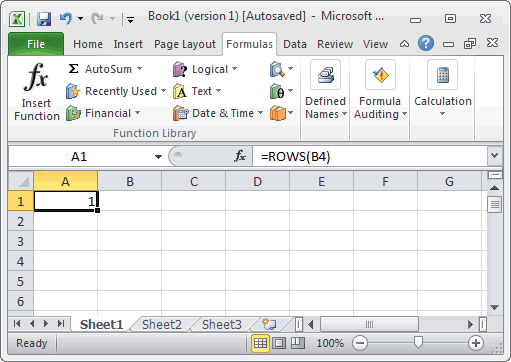
Microsoft Excel
Based on the Excel spreadsheet above, the following ROWS examples would return:
=ROWS(B4)
Result: 1

=ROWS(A4:B6)
Result: 3

=ROWS({1,2;3,4})
Result: 2

=ROWS({1,2,3,4;5,6,7,8})
Result: 2
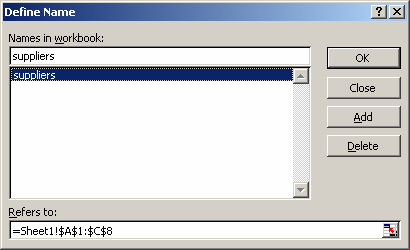
You can also defined a named range called suppliers that refers to Sheet1!$A$1:$C$8.
Microsoft Excel
Then using the ROWS function, you could refer to this named range as follows:
=ROWS(suppliers)
Result: 8

टिप्पणियाँ

इस ब्लॉग से लोकप्रिय पोस्ट

VLOOKUP Function

MS Excel:  How to use the VLOOKUP Function (WS) This Excel tutorial explains how to use the  VLOOKUP function  with syntax and examples. Description The VLOOKUP function performs a vertical lookup by searching for a value in the first column of a  table  and returning the value in the same row in the  index_number position. The VLOOKUP function is a built-in function in Excel that is categorized as a  Lookup/Reference Function . It can be used as a worksheet function (WS) in Excel. As a worksheet function, the VLOOKUP function can be entered as part of a formula in a cell of a worksheet. The VLOOKUP function is actually quite easy to use once you understand how it works! If you want to follow along with this tutorial, download the example spreadsheet. Download Example Syntax The syntax for the VLOOKUP function in Microsoft Excel is: VLOOKUP( value, table, index_number, [approximate_match] ) Parameters or Arguments value T...

TRANSPOSE Function

MS Excel:  How to use the TRANSPOSE Function (WS) This Excel tutorial explains how to use the Excel  TRANSPOSE function  with syntax and examples. Description The Microsoft Excel TRANSPOSE function returns a transposed range of cells. For example, a horizontal range of cells is returned if a vertical range is entered as a parameter. Or a vertical range of cells is returned if a horizontal range of cells is entered as a parameter. The TRANSPOSE function is a built-in function in Excel that is categorized as a  Lookup/Reference Function . It can be used as a worksheet function (WS) in Excel. As a worksheet function, the TRANSPOSE function can be entered as part of a formula in a cell of a worksheet. Syntax The syntax for the TRANSPOSE function in Microsoft Excel is: TRANSPOSE( range ) Parameters or Arguments range The range of cells that you want to transpose. Note The range value in the TRANSPOSE function must be entered as an array. To ...

How to use Vlookup

You can trap #N/A errors and display a friendly message In exact match mode, VLOOKUP will display the #N/A error when no match is found. In one way, this is useful because it tell you definitively that there is no match in the lookup table. However, #N/A errors aren't very fun to look at, so there are several ways you can trap this error and display something else instead. Once you start using VLOOKUP, you're bound to run into the #N/A error, which occurs when VLOOKUP isn't able to find a match. This is a useful error, because VLOOKUP is telling you clearly that it can't find the lookup value. In this example, "Latte" doesn't exist as a beverage in the table, so VLOOKUP throws an #N/A error